By late 2014, more than 50% of Indeed’s job search requests were from mobile devices, up from 10% just a few years earlier.
Among my responsibilities leading design at Indeed, I worked on the mobile website and created the Indeed iOS app. I was heavily involved with Indeed’s efforts to provide millions of job seekers all over the world excelent job search experiences – regardless of what device they may be using.
While finding a job on phones and tablets was more popular than ever, it was also often where the process of actually getting a job ended.
Opportunity
Once job seekers found a great job on their mobile device, they were often stuck when a job application required a resume:
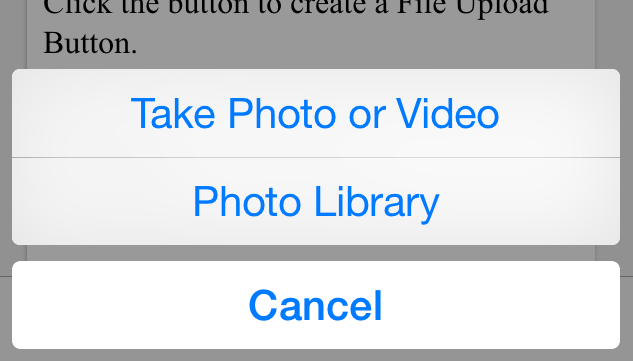
At the time, iOS didn’t provide users access to the file system. Interacting with a file input in a web view would prompt users to select a photo (see below).
Android users could upload a file, but needed access to their resume from their mobile device – not helpful if it’s saved on a desktop computer.
Millions of job seekers had created an Indeed Resume, but were typically limited to using it to apply to jobs posted directly on Indeed.
Detail of what users would see after interacting with a file input on iOS 7. There was no file system access, so users couldn’t submit a resume file, only an image or video.
The inability for job seekers to apply from mobile devices limited Indeed’s ability to generate revenue from mobile. A majority of the jobs advertised on Indeed couldn’t be applied to from mobile devices, so they weren’t advertised to mobile job seekers.
Along with a significantly smaller screen and the necessity to fill it will large, finger-tappable controls, finding a job on a mobile device was often significantly worse than using a desktop computer.
Ideation
Having built the Indeed iOS app, I knew it primarily displayed our mobile website to job seekers.
From my experience developing browser extensions, I also knew our iOS app had privileged access to the web pages viewed in our app – with capabilities “normal” Indeed web pages did not:
It had access to the URL of the page job seekers were viewing;
It could execute JavaScript in a web page and get a result;
It knew when requests had been initiated, and could analyze them before they were sent...even when the job seeker wasn’t on the Indeed website.
To help job seekers apply to jobs on mobile devices that required a resume, I imagined our native iOS app could replace HTML file inputs with a custom control that would include the users’ Indeed Resume when the form was submitted.
The ability to use a Indeed Resume to apply to any job that required a resume from a mobile device would have numerous benefits:
It made having the iOS app more valuable. Instead of just being an app-based version of our mobile website, it would do useful things our website was unable to do.
It increased the number of sponsored jobs we could show, increasing revenue and providing job seekers access to more sponsored jobs
It increased the number of jobs that could be applied to from a mobile device, improving job seekers ability to easily connect with employers
It made having an Indeed Resume more valuable. Not only was it a way for employers to find job seekers, it allowed them to apply to jobs on mobile devices
It didn’t require third-party buy-in. No agreements or code updates were necessary. Servers would receive the data they expected, and everything should just work.
In fact, while many aspects of finding a job on a mobile device was worse than using a desktop device, by leveraging unique features of our native mobile applications, I imagined the job search experience could actually be better on mobile.
Increasing job applications and revenue aligned to high-level company goals, and given the large (and growing) size of our mobile audience, this new functionality could be incredibly impactful.
To give you an idea of how impactful, let’s estimate that, at the time, nine-out-of-ten jobs were posted on third-party websites and did not use Indeed’s mobile-optimized apply process (Indeed Apply). If these jobs required a resume upload (many did), job seekers likely couldn’t apply. It’s easy to imagine addressing this issue could double the amount of job applications submitted from mobile devices, if not more.
I was excited to see if I could get it to work.
Prototyping & Iteration
To demonstrate my idea, I created a simple iOS prototype and a basic web page that worked together:
The iOS app displayed my basic web page.
When the web page finished loading, JavaScript was added by the iOS app, replacing all file inputs with a custom “Use Indeed Resume” control.
If a user chose to include their Indeed Resume, a hidden form field was added indicating resume data should be included in the POST request.
When the form was submitted, if the hidden form field was present, the iOS app would create a new POST request that included resume file data, and finally sent the POST request to the server.
My iOS prototype displayed a basic web page that included a file input, which was replaced with a custom “Use my Indeed Resume” control by the app. Interacting with the control and submitting the form would include a PDF file in the POST request.
Based on the prototype, I got buy-in from the Product team to add the functionality to the Indeed iOS app. While the prototype demonstrated what was possible, there was still work to be done.
For example, the app needed to include the users actual Indeed Resume (not just a example PDF like the prototype). Adding a preview of the job seekers’ resume would provide an opportunity for them to verify what was being submitted and update it before sending.
The iOS app was updated to display a preview when job seekers chose their Indeed Resume.
However, once all aspects of feature were completed, a rather obvious issue jumped out in my final review.
More Problems, More Solutions
While it was now technically possible to complete a job application that required a resume, many job applications during this time were still formatted for desktops, which meant mobile job seekers needed to pan and zoom to fill out complicated job application forms:
At the time, many job applications weren’t mobile optimized and looked like this. (In fact, this is an example of a job application today – in 2024! There’s ten more pages like this.)
Using an Indeed Resume on these websites wouldn’t matter if mobile job seekers had to deal with page after page of poorly designed forms to apply.
But just like it was possible to add JavaScript to replace file inputs, I thought we could add CSS to improve the formatting of job application forms.
Since all jobs from a particular website typically used the same template, we could quickly reformat many jobs using a small number of website-specific CSS rules.
Reformatting job application forms is a feature that would benefit Android app users as well.
Improving job application form UIs is something we could only do in our native applications, making them even more valuable.
I identified a small number of websites with large numbers of sponsored jobs, and a small team (me, a UX Designer, and an intern) wrote custom CSS to make the application forms mobile-friendly. Our mobile native apps were updated to apply site-specific CSS rules when users were in the test group.
Here’s a comparison of job applications from the same website. On the right, custom CSS rules have been added to reformat the form to fit properly on a mobile device and remove unnecessary visual design elements.
By the time everything was complete, the product changes had become more complex than I originally anticipated. One simple feature became two. While individual changes were relatively small, they were distributed across many parts of the application, requiring I collaborate with Engineers from Job Search backend, Job Search front-end, Indeed Resume, and our native mobile apps. I was contributing code, designs, and acting as the Product Manager.
Validation
A/B testing was used to determine the impact these new features had on job applications and revenue. The hypothesis was job seekers would apply to more jobs from our mobile apps now that they could submit their Indeed Resume and job application forms were formatted better, and since more sponsored jobs were eligible to be shown to mobile users, we’d see an increase in revenue.
Initial test results didn’t support this hypothesis. There was very little change in applications and revenue between the test and control groups.
To increase applications, changes were made to emphasize that job seekers could now apply to more jobs (which they couldn’t do before):
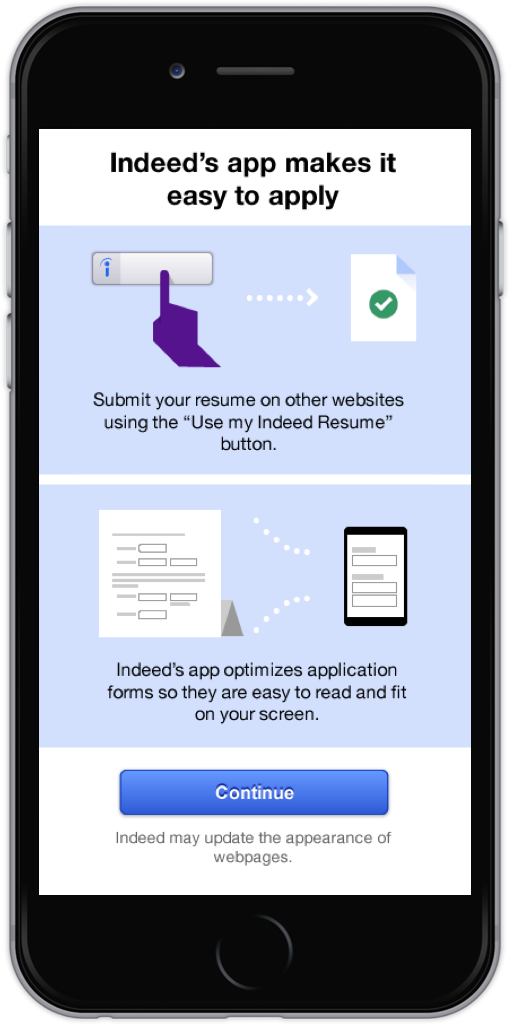
When job seekers first clicked-through to websites we could enhance, they saw an interstitial to educate them about the changes they could expect.
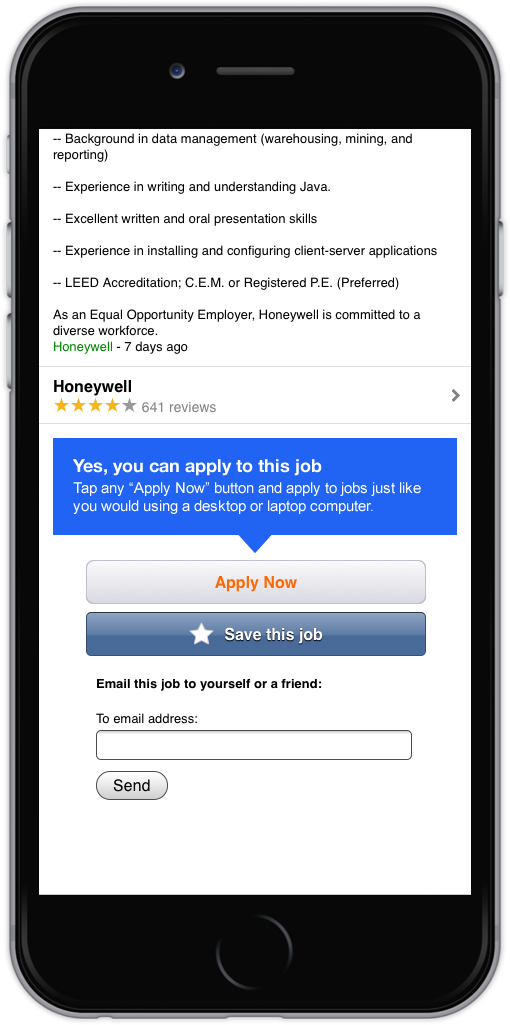
After several subtle approaches, a visually prominent callout was added to inform job seekers they could apply to these jobs from their mobile device. I thought, if this didn’t increase applies, nothing would,...
To increase applications, a prominent callout was added above the "Apply Now" button to encourage job seekers to apply to jobs on third-party websites.
…and in the end, it didn’t.
Results
It didn’t appear these features were having a significant positive benefit to job seekers.
Final test results indicated there was a slight increase in total applications, roughly 3% – which would have been a win if CSS reformatting of job application forms wasn’t so complicated. Developing the CSS wasn’t too difficult, but we’d have to spin-up and support a team to constantly maintain these rules and update them as necessary, ensuring we didn’t format applications incorrectly – this would become debt we’d have to pay forever. For 3% more applications, the effort wasn’t worth it.
The features didn’t significantly increase revenue either. We were substituting one set of sponsored jobs for another, and job seekers seemed equally willing to apply to them, resulting in similar revenue across groups.
Given the low impact the features provided, I recommended stopping testing and not rolling out these changes.
Summary
Even though this test was unsuccessful, it’s still one of the favorite things I’ve done.
It combined frustrating user experience issues with business opportunities and technical solutions. It was significantly different than what others inside and outside of Indeed were doing, and there was an opportunity for a tremendous upside if it had worked out.
And while my specific changes weren’t rolled out, important technologies developed during my test were adopted and provided value, leading to a significant increase in job applications from mobile users.
Many ideas sound like “good ideas,” but based on the data collected during testing it was clear this “good idea” didn’t produce “good” results. I’m glad I could share my idea with job seekers all over the world and learn from them.
I always want data to inform product changes I make, ensuring I’m providing value to customers and business, and not just creating a bunch of “good ideas” that don’t solve real problems.
My measure of success isn’t how hard I worked, it’s if I produced results.